
Curating and creating effective pre-class content is a central element of the Flipped Learning 3.0 Framework. In this framework, the individual learning space is where learners first engage with new content.
Therefore, the quality, structure, and design of pre-class materials are critical for successful learning processes in the group learning space. For adult learners in particular, materials should be relevant, clear, and manageable in length, considering their prior experience, limited time, and need for practical relevance.
From Passive to Active Learning Materials
A key principle in Flipped Learning 3.0 is that pre-class materials should not remain passive. Instead, they should be designed or adapted in a way that encourages active engagement. This means that learners should not only receive information, but also interact with it through thinking, reflecting, and applying knowledge.
This principle applies to all formats, including interactive videos, readings, podcasts, and interactive modules.
Please drag the text boxes in this activity onto the correct area. Check your selection!
Using Videos Effectively
Videos are widely used in flipped learning because they are accessible and can explain complex content clearly. However, videos are by nature passive learning media.
Without guidance, learners may simply watch without actively processing the content. To make videos more effective, they should be enriched with interactive elements such as embedded questions, reflection pauses, or short tasks.
They can also be combined with worksheets or note-taking guides that require active engagement. Interactive video tools can further support learning by tracking engagement and providing feedback.
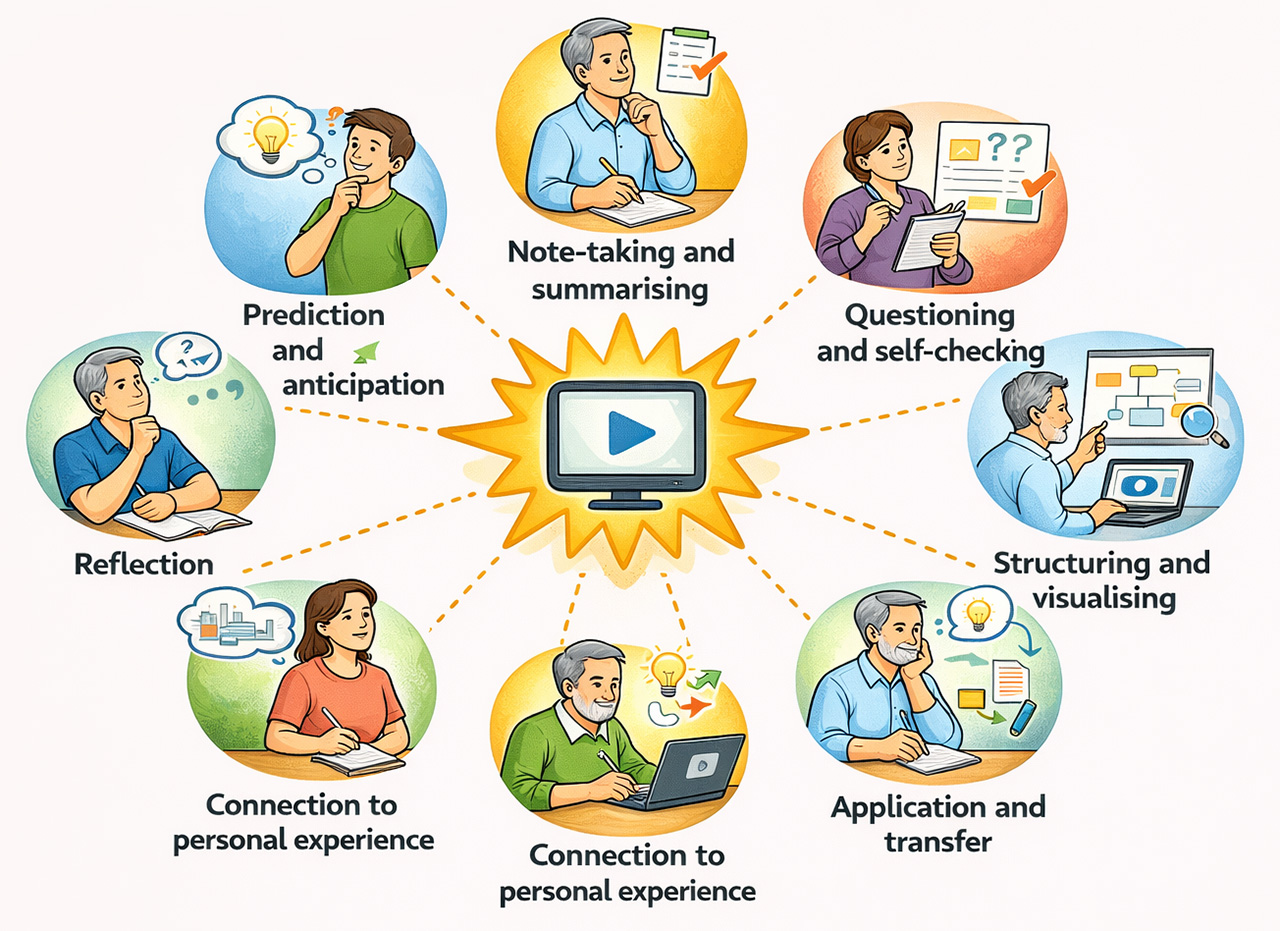
Eight methods to make a passive video to an active learning experience. The extended list is hidden in the spoiler below!
Activating Readings
Readings support more in-depth understanding and allow learners to work at their own pace. However, they can also remain passive if learners are not guided.
To make readings more active, educators can include guiding questions, highlight key ideas, or assign tasks such as summarising, reflecting, or applying concepts. Additional strategies include annotation tasks, comparison activities, or short written responses that promote more profound engagement.
Making Podcasts Interactive
Podcasts offer flexibility and are especially useful for storytelling, interviews, or explaining concepts in an accessible way. However, like videos, they are primarily passive.
To activate learning, podcasts should be combined with listening tasks, reflection questions, or follow-up activities. Learners can be asked to identify key ideas, connect content to their own experience, or prepare questions for discussion in the group space.
The Role of Interactive Modules
Interactive modules are particularly powerful for active learning. They combine different media formats with built-in activities such as quizzes, simulations, or decision-making tasks.
These formats naturally require learners to engage, respond, and apply knowledge. Within the Flipped Learning 3.0 Framework, interactive modules are therefore especially suitable for efficient and active pre-class learning.
Designing for Engagement
The most effective pre-class materials are those that actively involve learners. While videos, readings, and podcasts provide important input, they become truly valuable when combined with tasks that promote interaction and reflection. Interactive modules, in contrast, are inherently active and particularly effective.
A well-balanced combination of different formats, aligned with learning objectives and adapted to adult learners’ needs, creates a strong foundation for meaningful and engaging learning in the group space.