In Flipped Learning, learners do not all follow the same path. They come with different levels of prior knowledge, different learning styles, and different goals. Personalisation means recognising this diversity and designing learning experiences that give every learner a genuine opportunity to succeed – at their own pace, in their own way.
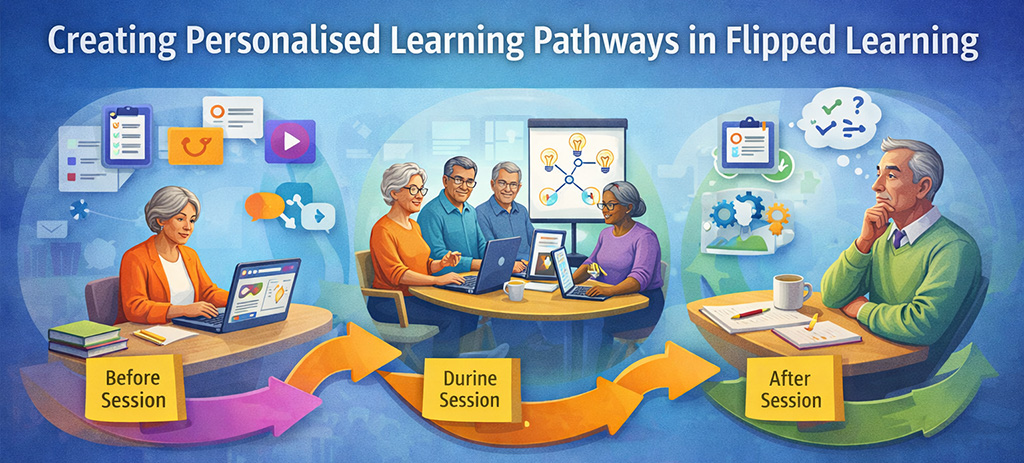
This is not about creating an entirely different course for every individual. It is about building in flexibility, choice, and support at every stage of the learning journey.
Before the Session – Individual Learning Space
The Individual Learning Space is where personalisation begins. Before the group session, learners engage with new content independently. This is the ideal moment to find out what they already know – and to offer them options that match where they are.
Know Your Learners Before You Begin
A short pre-class quiz helps educators understand the prior knowledge of their learners. It does not need to be long – three to five questions are often enough to reveal where learners feel confident and where they need more support. The results help you plan the group session much more effectively.
Practical suggestion: Use a simple online tool such as Google Forms, Mentimeter, or your learning platform’s built-in quiz function. Keep the questions low-stakes and frame them as a self-check rather than a test.
Inclusion tip: Make sure your quiz is accessible. Use plain language, avoid complex sentence structures, and offer the option to respond in different ways – for example, multiple choice rather than open text – to support learners with literacy challenges or learning differences.
Offer Materials at Different Levels
Not every learner needs the same starting point. Offering materials at basic, intermediate, and advanced levels allows each person to engage with content that genuinely challenges them – without leaving anyone behind.
Practical suggestion: For each topic, prepare three short resources. A foundational explainer for those new to the subject, a standard resource for most learners, and an extension resource for those who want to go deeper. Label them clearly so learners can choose confidently.
Inclusion tip: Include materials in different formats – video with subtitles, written text, and audio recordings. This supports learners with visual impairments, hearing impairments, reading difficulties, or simply different preferences. Where possible, provide transcripts for all video content.
Give Learners a Choice of Format
Some people learn best by watching, others by reading, and others by listening. Offering the same content in different formats is one of the simplest and most effective ways to personalise learning.
Practical suggestion: Record a short video explanation, write a concise text summary, and – where resources allow – provide a brief audio version. Even offering just two formats makes a meaningful difference.
Inclusion tip: For learners with dyslexia, consider using a sans-serif font, increased line spacing, and a pastel background colour for written materials. Tools such as the Immersive Reader in Microsoft 365 can also help significantly.
Let Learners Set Their Own Goals
When adult learners have a say in what they want to achieve, their motivation increases. Inviting them to set a short personal learning goal before beginning a unit connects the content to their own lives and needs.
Practical suggestion: Add a short prompt at the beginning of each unit: “What do you already know about this topic? What would you like to understand better by the end?” This can be done in a journal, a digital document, or directly on the learning platform.
Inclusion tip: For learners who find open-ended goal-setting difficult, offer a structured template with sentence starters: “I already know… I would like to learn… I think this will help me because…”
Include Self-Check Questions and Optional Extensions
Self-check questions allow learners to assess their own understanding before arriving at the group session. This builds metacognitive awareness and helps learners arrive better prepared.
Optional extension materials – clearly labelled as extra, never compulsory – give curious or advanced learners the opportunity to explore a topic more deeply without creating pressure for others.
Practical suggestion: Place self-check questions at the end of each pre-class resource. Use them as a moment of reflection rather than assessment. Optional materials can be collected in a clearly labelled section called “Want to know more?” or “Going deeper.”
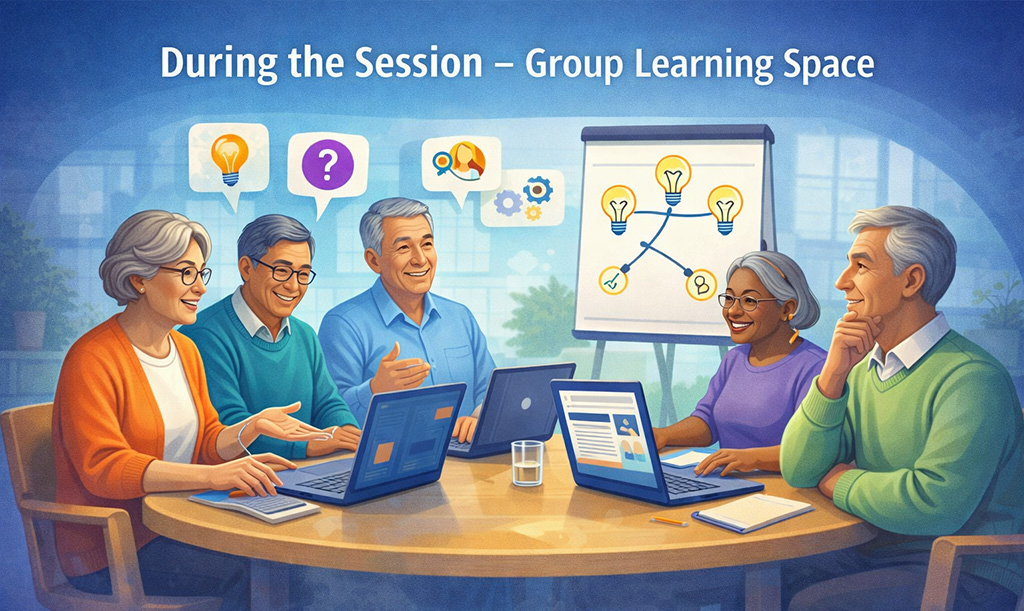
During the Session – Group Learning Space
The Group Learning Space is where the real value of Flipped Learning unfolds. Because learners have already engaged with the content individually, the group session can focus entirely on application, discussion, collaboration, and more profound understanding. This is also where personalisation becomes most visible.
Observe and Adapt
At the start of the group session, take a moment to check in with learners. A simple question – “How did you find the pre-class material?” – provides you valuable information. Use what you observe to adjust tasks on the spot.
Practical suggestion: Keep a simple observation grid with learner names. Note who seems confident, who has questions, and who may need additional support or a greater challenge. This does not need to be formal – a quick mental note or a brief written record is enough.
Inclusion tip: Some learners may not feel comfortable expressing difficulties in front of the group. Provide a discreet way to share concerns – for example, a small card system (green = I’m fine, yellow = I have a question, red = I need help) or a private message function on your platform.
Create Flexible Groups
Grouping learners thoughtfully makes a significant difference. Mixed-ability groups encourage peer support and collaborative learning. Like-ability groups allow you to provide targeted support or more challenging tasks where needed. The key is to vary your grouping approach rather than keeping the same groups every session.
Practical suggestion: Try different grouping strategies across sessions – random groups, self-selected groups, interest-based groups, and educator-assigned groups. Each approach offers different benefits and keeps the learning dynamic fresh.
Inclusion tip: Be mindful of social dynamics. Some learners – particularly those with anxiety, autism spectrum conditions, or language barriers – may find group work challenging. Offer clearly defined roles within each group (facilitator, note-taker, timekeeper, presenter) so every learner knows exactly what is expected of them.
Offer Differentiated Tasks
Within the same session, different learners can work on different versions of the same task – one at a foundational level, one at standard level, and one with additional challenge. This does not mean a different lesson for every learner. It means designing tasks with built-in flexibility.
Practical suggestion: Use a “must, should, could” structure. All learners complete the core task (must). Those who finish early move to the extension (should). Those who want an additional challenge take on the stretch task (could). Label these clearly so learners can navigate them independently.
Inclusion tip: Ensure that the foundational task is genuinely accessible, not simply easier. Consider whether the task requires reading or writing, and offer alternatives such as verbal responses, drawings, or digital tools where appropriate.
Encourage Peer Support and Collaboration
Adult learners bring a wealth of experience to the group. Structured peer support allows learners to share knowledge, explain concepts to each other, and build confidence.
Practical suggestion: Use think-pair-share activities, peer feedback protocols, or collaborative problem-solving tasks. When a learner explains something to a peer, both benefit – the explainer reinforces their understanding, and the listener gains a perspective that may be easier to relate to than the educator’s explanation.
Inclusion tip: Pair learners thoughtfully. Consider language backgrounds, confidence levels, and interpersonal dynamics. For learners who are new to a language or culture, being paired with a supportive, patient peer can make the difference between engagement and withdrawal.
Ask Guiding Questions and Give Individual Feedback
Rather than addressing the whole group at all times, move around the room and engage with individuals and small groups. Ask open questions that encourage thinking rather than simply providing answers.
Practical suggestion: Prepare five to seven guiding questions before each session. Use them flexibly depending on where learners are in their understanding. Questions such as “What made you choose that approach?” or “What would happen if…?” promote deeper thinking at any level.
Inclusion tip: Be aware of cultural differences in how learners respond to questions. In some cultures, being asked a direct question in front of others can feel uncomfortable. Offer learners the option to discuss in pairs before sharing with the group.
After the Session – Post-Class
The post-class phase is often underused, yet it is one of the most powerful opportunities for personalisation. This is where learners consolidate what they have learned, reflect on their experience, and prepare for what comes next.

Build in Meaningful Reflection
A short reflection task at the end of a learning unit helps learners process their experience and identify what they still need to work on. Reflection does not need to be long – even five minutes makes a real difference.
Practical suggestion: Use a simple structure such as: “What did I learn today? What is still unclear? What will I do differently next time?” This can be completed in a written journal, a voice recording, or a short digital entry on the learning platform.
Inclusion tip: For learners who find written reflection difficult, offer alternatives – a voice memo, a short drawing or mind map, or a verbal check-in with the educator. The format matters less than the act of reflection itself.
Provide Follow-Up Activities at Different Levels
Not every learner leaves the session with the same level of understanding. Post-class activities should reflect this. Offer a range of follow-up tasks – some to consolidate core learning, some to address gaps, and some to extend understanding further.
Practical suggestion: Label follow-up activities clearly: “Consolidation” for those who want to reinforce what they have learned, “Review” for those who need to revisit something, and “Extension” for those who want to go further. Allow learners to choose the activity that best matches their needs.
Inclusion tip: Avoid making review tasks feel like a punishment for not understanding. Frame them as a normal and valuable part of learning. Use language such as “Take another look at this – it is worth the extra time” rather than “If you did not understand…”
Offer Personal Feedback and Check-Ins
Individual feedback – even a brief written comment or a short one-to-one conversation – signals to learners that their progress is noticed and valued. This is particularly important for adult learners, who may have had negative experiences with education in the past.
Practical suggestion: Use your learning platform’s feedback or messaging function to send short, personalised comments after each unit. Focus on what the learner did well and one specific area to develop. Keep it brief, specific, and encouraging.
Inclusion tip: Be sensitive to literacy levels when writing feedback. Use plain language, short sentences, and a warm, constructive tone. For learners with low confidence, a single positive observation can be more powerful than a detailed critique.
Allow Learners to Adjust Their Goals
Learning goals set at the beginning of a unit may need to change as the unit progresses. Giving learners the opportunity to revisit and adjust their goals reinforces their sense of ownership and agency.
Practical suggestion: At the end of each unit, invite learners to return to the goal they set at the beginning: “Did you achieve what you set out to do? Has your goal changed? What is your next step?” This simple practice builds self-regulation over time.
Connect Learning to Real Life
Adult learners are most motivated when they can see the relevance of what they are learning to their own lives, work, or community. Post-class is a natural moment to make these connections explicit.
Practical suggestion: Suggest two or three real-life application ideas at the end of each unit, drawn from different contexts – workplace, family, community, or personal interest. Invite learners to share how they have applied something they learned. This can be done in a short forum post, a group message, or at the start of the next session.
Inclusion tip: Be mindful that “real life” looks different for every learner. Avoid assumptions about employment, family structure, or lifestyle. Offer a range of application contexts so every learner can find one that resonates.
The Key Idea
Personalised learning in Flipped Learning is not about doing more work. It is about designing smarter – building in flexibility, choice, and support so that every learner can engage meaningfully at every stage of the journey.
When learners feel seen, supported, and trusted to take ownership of their learning, something important happens: they become more confident, more motivated, and more resilient. That is the real goal of personalisation – not just better results, but better learners.