
In the Flipped Learning 3.0 Framework, learning moves beyond traditional lectures towards more active and engaging learning experiences. The group learning space is no longer mainly used for delivering content.
Instead, it becomes a space where learners apply knowledge, work together, and deepen their understanding. This shift is especially important for adult learners, who benefit from practical, relevant, and interactive learning activities.
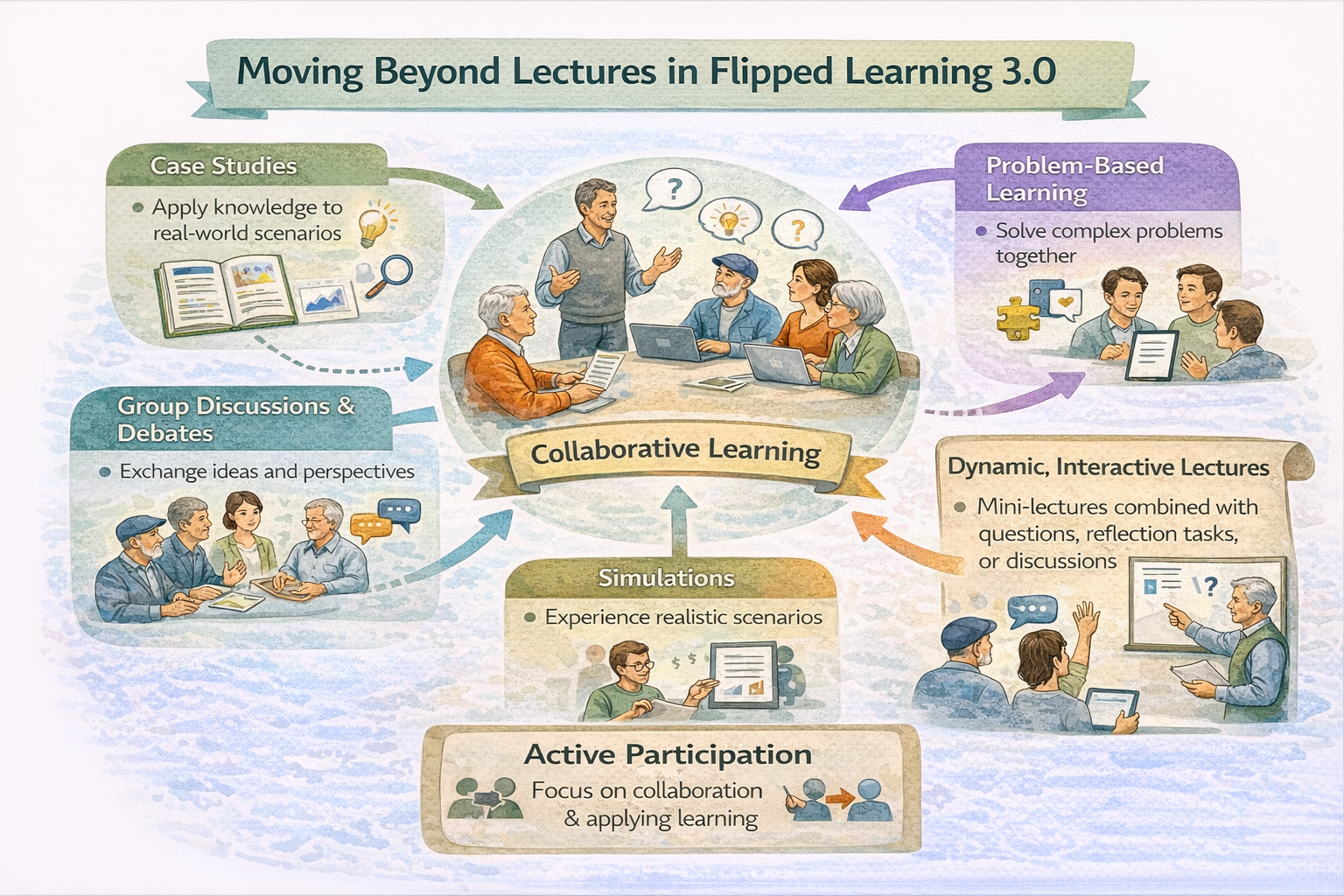
Active Learning Strategies for Adult Learners
Flipped Learning 3.0 promotes a wide range of active learning strategies that support more in-depth understanding and meaningful engagement. Case studies allow learners to work with real-life situations and apply their knowledge to practical problems.
Problem-based learning encourages learners to explore complex questions and develop solutions collaboratively. Group discussions and debates create opportunities to exchange ideas, reflect on different perspectives, and build critical thinking skills.
Simulations offer safe environments where learners can practise decision-making and experience realistic scenarios. Role-plays are an attractive group activity to practice languages in language learning. Peer teaching is another powerful method, where learners explain concepts to each other, reinforcing their own understanding while supporting others.
These strategies help learners become active participants in the learning process rather than passive recipients of information.
Interactive Active Learning Reference Tool
Explore four active learning strategies, compare them, and check your understanding.
1. Browse active learning strategies
2. Compare two strategies
Select two strategies and compare their purpose, use, strengths, and challenges.
3. Self-check quiz
Answer four short questions to confirm your understanding.
The Value of Lectures in an Active Learning Context
It is important to note that lectures are not inherently ineffective. A lecture can be valuable when it is designed in an interactive and engaging way. Short input phases, combined with questions, reflection tasks, or discussions, can make lectures more dynamic and meaningful.
For example, an educator might pause during a lecture to ask questions, invite opinions, or connect content to learners’ experiences. In this way, even a lecture can support active learning if it involves learners and encourages participation.
Collaborative Learning as a Core Element
Collaborative learning is a central pillar of Flipped Learning 3.0. Working together allows learners to share knowledge, learn from each other, and develop social and communication skills. For adult learners, collaboration is particularly valuable because it connects learning to real-life situations and diverse perspectives.
Group work, peer feedback, and joint problem-solving activities create a supportive learning environment where learners actively contribute to the learning process. The educator’s role is to guide these interactions, ensure participation, and support meaningful exchange.
From Passive Listening to Active Participation
Flipped Learning 3.0 transforms the learning experience by shifting the focus from passive listening to active participation. By combining different active learning strategies and encouraging collaboration, it creates a more engaging, relevant, and effective learning environment for adults.
At the same time, it recognises that even traditional elements such as lectures can play a role when they are used in an interactive and learner-centred way.