
Flipped Learning 3.0 offers a powerful and flexible approach to teaching and learning. But like any pedagogical framework, it comes with real challenges – particularly when working with adult learners, who bring a wide range of experiences, circumstances, and expectations to the learning environment.
The good news is this: most challenges in Flipped Learning are not signs that the approach is wrong. They are signals that something needs to be adjusted. Recognising difficulties early – and responding with practical, learner-centred solutions – is itself a core skill of effective Flipped Learning practice.
The Most Common Challenges
From the experience of the last decade, you should not take an existing training course and “modify it for Flipped Learning 3.0”. You will fail with this strategy.
Flipped learning courses must be developed new more or less from the scratch to match with the approach. Besides this, other challenges or obstacles may appear with Flipped Learning 3.0 Courses.
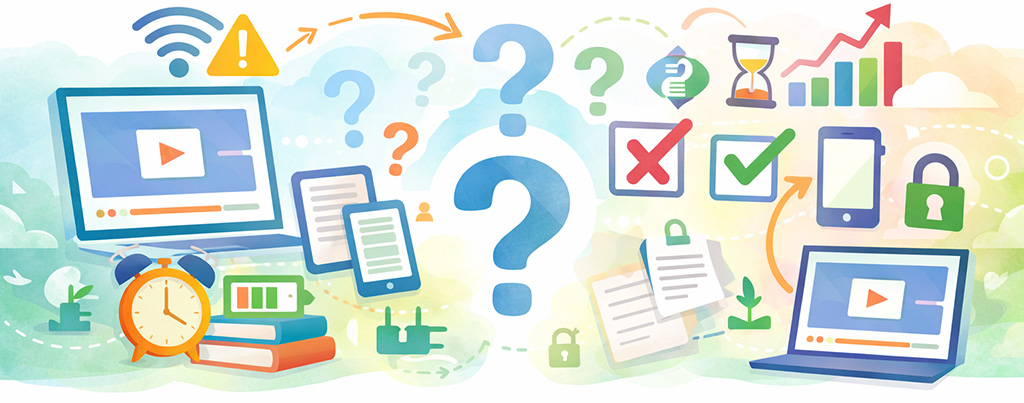
Limited Access to Technology
Every learner can succeed when we plan for different access levels—together, we will find solutions that make learning possible for everyone!
Not every learner has reliable access to a device, a stable internet connection, or a quiet space to engage with pre-class materials. This is one of the most frequently encountered barriers in adult learning contexts, and it deserves to be taken seriously rather than assumed away.
What helps: Find out about your learners’ access situation early – ideally before the course begins. Offer offline alternatives where possible, such as downloadable materials or printed resources. Allow flexibility in when and how pre-class tasks are completed. And never design a learning experience that excludes a learner simply because they do not have the same technology as others.
Low Digital Confidence
You are more capable than you think—step by step, we will grow digital skills and build confidence side by side!
Access to technology is one thing. Confidence in using it is another. Many adult learners – particularly those returning to education after a long break – may feel uncertain about navigating learning platforms, submitting tasks digitally, or using unfamiliar tools.
What helps: Introduce digital tools gradually and always explain the purpose before the process. A short orientation session at the start of a course can significantly reduce anxiety. Pair less confident learners with more experienced peers where appropriate, and make it clear that asking for technical help is always welcome.
Low Motivation or Passive Learning Habits
This new approach will energize you—each small step forward will show how much you can achieve when you lead your own learning!
Some adult learners have spent years in traditional learning environments where the educator did most of the work. Being asked to engage independently before a session – and to take an active role during it – can feel unfamiliar or even uncomfortable at first.
What helps: Be transparent about the Flipped Learning approach from the beginning. Explain why the structure works the way it does, and what learners will gain from it. Start with short, manageable pre-class tasks to build the habit gradually. Celebrate small wins, and make the connection between pre-class preparation and in-class experience as visible as possible.
Lack of Time
We respect your time—short, focused tasks will fit into your life, helping you learn effectively without overwhelm!
Adult learners typically have significant commitments outside their studies – work, family, and community responsibilities that compete for their time and energy. Lengthy or poorly designed pre-class materials can quickly become a source of stress rather than support.
What helps: Keep pre-class materials short and focused. A five to ten minute video or a concise reading is almost always more effective than a lengthy resource that learners abandon halfway through. Be realistic about what can be achieved in the time available, and communicate clearly about expectations.
Uneven Preparation Levels
Even with the best pre-class design, learners will arrive at the group session with different levels of preparation. Some will have engaged deeply; others may not have had time, or may have found the material difficult. This is normal – and it needs to be planned for.
What helps: Begin each group session with a brief check-in rather than assuming a uniform starting point. Use quick formative assessment tools to get a sense of where learners are, and design in-class activities that can flex to accommodate different levels of preparation. Avoid framing lack of preparation as a failure – instead, build structures that allow all learners to engage meaningfully regardless of how much pre-class work they completed.
A Shift in Perspective
Many of the challenges in Flipped Learning 3.0 are not new. They exist in traditional learning environments too – they are simply made more visible by a framework that asks learners to take a more active role.
That visibility is actually an advantage. When challenges surface early, they can be addressed early. When learners feel that their difficulties are noticed and taken seriously, trust grows – and trust is the foundation of any effective learning environment.
The goal is not a perfect Flipped Learning experience from day one. The goal is responsive – where both educator and learner are continuously reflecting, adjusting, and moving forward together.